You’re Not Getting Your Writing Done Because You’re Building the Wrong Habit

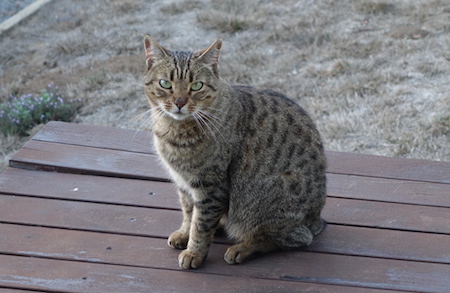
Tom’s cat. No, it’s not a tomcat.
Editor Tom asks how we manage to start writing projects without bedeviling ourselves.

Short version: make it a habit.

Slightly longer version: make it the right habit.

Full version:

After 18 months of experimentation (following 18 years of dabbling) I’ve made writing my habit. It’s part of my daily routine.

Every morning, Best Beloved and I have our tea and a chat. Then, I go downstairs and write one scene (+/- 1,000 words is where mine seem to fall.)

… more … “You’re Not Getting Your Writing Done Because You’re Building the Wrong Habit”

How I Write

Or, more accurately, how I begin the process of moving toward my books.

Planning is a left-brain process. Creativity has to have a healthy dose of right brain. You need both. The apocryphal Hemingwayesque “write drunk, edit sober.”

[image: many-books]

Here’s a very short version of my story-generating process, which thus far has given me good results blending left and right, analytical and creative: … more … “How I Write”

“There are only two possible dialog tags,” he said.

[image: quotes]Picture the scene:

You and a friend are having lunch by the water. Their phone rings. They chat for a moment, hang up, and turn to you and tell you it was Bob.

If you’re nosy, you ask a question.

“What did he . . . ” What?

Aver? Shout? Insist? Snarl?

… more … ““There are only two possible dialog tags,” he said.”

Longer Books Through Better Planning

[image: Anodyne-cover-2015]Elizabeth Spann Craig’s Twitterific writing links a couple weeks back led me to Ryan Lanz writing about stretching your word count.

In a moment of weakness, worried that Anodyne is too short, I followed it.

Expecting smarmy tricks, I found solid advice, which if implemented properly and with good motives is, what’s the phrase I’m looking for . . . oh yes; Good Stuff.

The 5 stretches listed by Lanz:

… more … “Longer Books Through Better Planning”

Think Like a Writer (You Want This Book)

[image: Think-Like-a-Writer]My friend, sometime lyricist, and most excellent editor Tom Bentley has finally released a book on writing.

Think Like a Writer: How to Write the Stories You See is both practical and entertaining. Much like its author, come to think of it.

I’ll let Tom tell you about it:
… more … “Think Like a Writer (You Want This Book)”

Your Character’s Symbol

[image: yellow trash]Well-written television has much to teach a novelist. The visual nature of its exposition reaches our brain differently.

It’s how Longmire taught me about assigning your character a symbol. It’s a concept I haven’t fully explored yet, but when it comes to Sheriff Walt Longmire, it’s been a powerful tool.

Walt hates trash. His small town deserves better, so from the first episode it’s a common scene for Walt to stop as he crosses the street to pick up some bit of trash and toss it where it belongs.

At first, it’s just Walt, picking up a gum wrapper.

… more … “Your Character’s Symbol”

Gathering Structural Support

I’m gathering resources to create some kind of structure checklist for my writing and wanted to share 3 useful lists and concepts I’ve encountered the past week.

[image: structural support]

… more … “Gathering Structural Support”

Minimum, Conservative, Necessary: Overdoing Character’s Actions

[image: doing nothing]“Why did they do that?

When you find yourself wondering why a character in a book or on screen is taking certain action, sometimes the problem is nature.

Nature conserves energy, physical and mental. We don’t take actions which we don’t believe are the minimum conservative necessary action. Our wiring makes us look for the easy solution to whatever comes our way. And if it’s something we can ignore, inaction is the ultimate conservation. We do nothing. Lots of it.

Making our characters do something because it’s good for the story is weak writing. Readers will sense something’s amiss because they instinctively grasp nature’s imperative.

I’m highly unlikely to walk out to the frozen edge of the lake and look around, just so some storyteller can make me find a body and let them get on writing their mystery.

… more … “Minimum, Conservative, Necessary: Overdoing Character’s Actions”

Snare Your Readers with Open Loops

[image: Scheherazade]Much that is popular doesn’t pass muster with me. Music, books, food, travel, clothing: if it’s trendy, I’m probably not there. Not because I dislike being trendy; far from it. I love being the center of attention, being one of the cool kids, as much as (or more than) most. My tastes don’t seem to line up with popular. Probably plays a role in why I’m not.

What’s popular in all those categories is what sells. In each, there are lessons I can learn. We can eschew the package and order a la carte.

Over at the Writer’s Village, writer and coach John Yeoman hosted Anthony Metivier’s article 13 Reasons Why I Love James Patterson – And You Should Too. Metivier comes at Patterson from all angles. Number eight is a writing lesson I’ve been seeing without learning for ages.

… more … “Snare Your Readers with Open Loops”

Coming About; or, Aiming the Boat in a Different Direction

[image: Cap'n Fiona on the Star of India with Mommy and Daddy]Someone described the method of steering a sailboat called “tacking” as first sailing in a direction to the left of where you want to go, and then sailing in a direction to the right of where you want to go. The process of shifting from left to right is called “coming about.”

Get on a sailboat and everyplace you want to go is against the wind. Forces external to the boat, such as wind and currents and other boats, cause you to adjust your heading, even if you haven’t changed your destination. That’s also a possibility: discovering that the beach you’re heading for is crowded, but over that way is an open spot you’d prefer.

Same with any business venture.

… more … “Coming About; or, Aiming the Boat in a Different Direction”